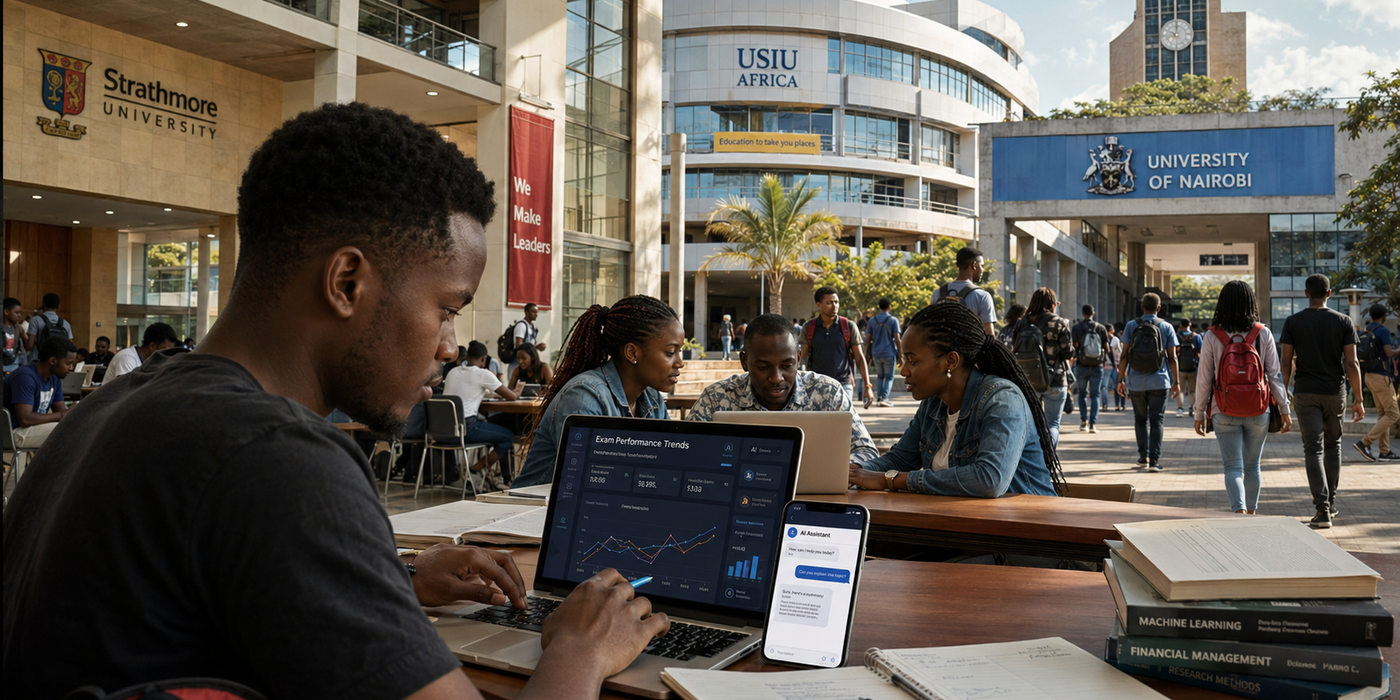
AI in the Kenyan University: From Admin Queues to Exam Prep
A look at how artificial intelligence tools are reshaping academic life at Kenyan universities, and what this means for students navigating fee structures, research deadlines, and high-stakes examinations.
For most students at Kenyan universities, a significant part of academic life has nothing to do with lectures. It is the time spent in queues at the registrar, waiting on WhatsApp groups for fee deadlines, or trying to find the right person to ask about supplementary examination procedures. These are not small inconveniences. For a student on a tight schedule, they represent hours that could have gone into revision, assignments, or rest.
That is beginning to change.
Artificial intelligence tools built specifically for the East African university context are helping students get accurate answers faster, prepare more strategically for examinations, and spend less time navigating administrative complexity. The shift is happening quietly, but it is real.
The Problem AI Is Solving
Kenya has more than 70 accredited universities. Each has its own fee structure, academic calendar, examination regulations, and postgraduate admission procedures. For new students and even continuing ones, the volume of institutional information is genuinely difficult to navigate.
A student at Strathmore University trying to understand the difference between a supplementary and a special examination, or a student at the University of Nairobi trying to find the self-sponsored fee schedule for a specific faculty, has traditionally had one option: go to the relevant office and ask. The office may be open between 8 and 5, excluding lunch. There may be a queue.
An AI assistant trained on institutional data changes this. The student gets an accurate answer in seconds, at any time of day, without leaving the library.
Exam Preparation Is Changing
Beyond administrative queries, AI is influencing how students prepare for examinations.
Prediction tools that analyze past papers can identify which topics appear most frequently, how question styles shift across years, and which areas carry the most marks. A student preparing for an accounting paper can use these tools to prioritize rather than attempt to cover every topic in equal depth.
This kind of strategic preparation is not new. Lecturers have always advised students to focus on high-yield areas. What AI adds is speed and specificity. A tool can process several years of past papers in seconds and surface patterns that would take a student hours to identify manually.
The accuracy of these tools depends entirely on the quality and breadth of the data they are trained on. A tool trained on past papers from Strathmore's BCOM Course will be genuinely useful for a student in that program. A generic AI tool will not.
Research and Writing
The second area where AI is making an impact is academic writing and research.
Finding journal articles, structuring arguments, formatting references, and ensuring that a paper meets departmental requirements are tasks that consume significant time. AI writing assistants can help with all of these, though the responsibility for intellectual content and academic integrity remains with the student.
The relevant distinction is between using AI to help structure and format work, which is generally acceptable, and using it to generate content that is submitted as one's own, which is not. Kenyan universities are beginning to develop explicit policies on this, and students should familiarize themselves with their institution's specific guidelines.
What Remains Human
AI tools handle information retrieval and pattern recognition well. They do not handle relationships, judgment, or context that has not been captured in data.
A lecturer who knows a student's learning history, a classmate who has just come out of an exam and can explain what the examiner emphasized, an academic advisor who understands a student's personal circumstances well enough to suggest a course of action: none of these are replaceable by current AI systems.
The students who will benefit most from AI tools are those who use them to handle the routine and the repetitive, freeing up time and cognitive energy for the parts of academic life that require genuine human effort.
Accessibility and Cost
One constraint worth noting is cost. High-quality AI tools are not free, and student incomes in Kenya are not uniform. Any serious effort to integrate AI into Kenyan academic life must grapple with accessibility, including affordable pricing tiers and mobile-first design for students who access everything through a smartphone.
The best tools in this space are built with this in mind. M-Pesa integration, low-bandwidth performance, and pricing that reflects local economic realities are not optional extras. They are baseline requirements for meaningful reach.
A Note on Institutional Data
The usefulness of an AI assistant is directly tied to the quality of the information it has been trained on. An assistant that has access to accurate, current data about a specific institution will outperform a general-purpose tool for that institution's students every time.
This has implications for universities as well as for the companies building these tools. Institutions that make their data accessible and structured will serve their students better. Those that do not will find that students use general-purpose tools that are less accurate for their specific context.
The quiet revolution in Kenyan university classrooms is, at its core, a data problem as much as a technology problem. The technology is ready. The question is whether the data, the policies, and the pricing structures will catch up.